
How We Got Here: The Long Road to The Impossible Airplane
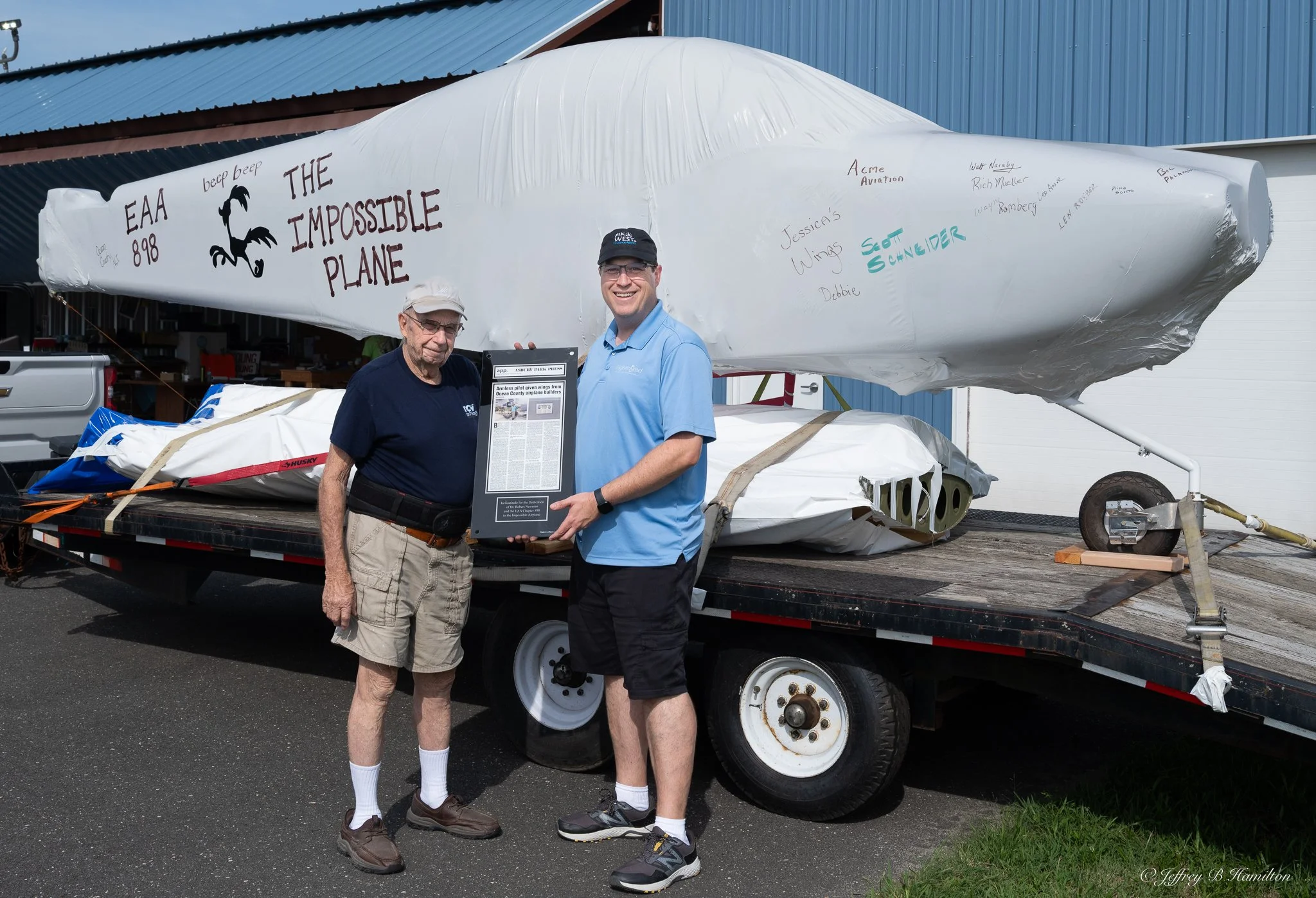
Dr. Robert Newman (EAA Chapter 898) and Patrick Chamberlain (RFI’s Inclusive Engineering Director) stand next to The Impossible Airplane as it leaves Ocean County Airport for Falcon Field.
A few weeks from now, if everything goes according to plan, an airplane that has been more than five years in the making will leave the ground for the first time.
It is easy to look at The Impossible Airplane today and see an RV-10, a set of custom flight controls, a long list of sponsors, and thousands of hours of work.
But this project didn’t start with any of those things.
It started with an Ercoupe.
The airplane that started everything
In 2019, someone donated a 1946 Ercoupe 415-C, N26R, to Rightfooted Foundation International.
For Jessica, that airplane was already something special. The Ercoupe is the same model she learned to fly and earned her Sport Pilot certificate in. Unlike almost every other airplane, the Ercoupe was designed without rudder pedals. The rudder and ailerons are linked together through the control yoke, which allows Jessica to fly the airplane with one foot on the yoke and the other controlling the throttle.
N26R was not specially adapted for Jessica. It was essentially a stock 1946 airplane that happened to have a control system she could use.
And it worked remarkably well.
Then we started asking it to do things it was never really meant to do.
By 2020, RFI was receiving invitations that went far beyond local flying. People wanted RFI and Jessica to bring the airplane to events around the country. There were invitations to EAA AirVenture. Eventually there would be an opportunity to fly into JFK. And in July 2020, Jessica flew with retired U.S. Senator Tom Harkin, the principal Senate sponsor of the Americans with Disabilities Act, during the ADA’s 30th anniversary.
That flight itself was incredible.
Getting there—and especially getting home—was another story.
The Ercoupe is a wonderful airplane, but ours was built in 1946. It is small, relatively slow, and much happier flying shorter trips than trying to cross a continent.
On the trip home from the Harkin flight, we spent nearly two weeks working our way back to Arizona. Headwinds seemed almost constant. Weather repeatedly changed our plans. We made small hops whenever conditions gave us an opening and waited when they didn’t.
The trip proved that the Ercoupe could take Jessica across the country.
It also convinced me that we probably shouldn’t keep asking it to.
“Are you up for a wild idea?”
It was the middle of the COVID lockdowns in 2020 when I asked Jessica a question: “What if we built an airplane for her?”
Not found an existing airplane that she could figure out how to fly.
Not took another old airplane and made a few accommodations.
What if we started with an airplane capable of doing the traveling RFI wanted to do and designed the controls around Jessica from the beginning?
Jessica was up for the wild idea.
The next question was whether anyone in the aircraft industry would be.
During Thanksgiving week of 2020, we met with leadership from Van’s Aircraft in Oregon. This was still the height of COVID precautions, so our first serious meeting about the future of this airplane happened in a socially distanced circle inside a large, well-ventilated aircraft hangar.
We met with Van’s founder Dick VanGrunsven, chief engineer Rian Johnson, Greg Hughes, and Rob Hickman.
We explained what we wanted to do.
They jumped on board.
Why the RV-10?
We looked through the Van’s lineup and thought carefully about what this aircraft actually needed to accomplish.
The Ercoupe had already taught us an important lesson: being able to fly an airplane was only part of the problem.
We needed an airplane that could actually be useful.
We wanted four seats so we could bring another person along, carry equipment, or eventually travel to visit the families RFI serves. We needed enough useful load for meaningful cross-country travel. We wanted a proven design with a strong record behind it.
Those requirements kept leading us back to the RV-10.
It was much more airplane than the Ercoupe—and that was precisely the point.
The idea eventually became what we now call The Impossible Airplane: an RV-10 with custom controls designed so Jessica can operate the airplane with her feet.
There was one immediate problem.
There was a long waiting list for kits.
So while we waited, we decided to tell the world what we were doing.
In 2021, at EAA AirVenture Oshkosh, Jessica announced that she planned to move from the two-seat Ercoupe into a four-seat RV-10 and pursue the medical and private-pilot pathway necessary to fly it.
At that point we had an airplane design, support from Van’s, and a big idea.
What we did not have was any idea who was going to build it.
A jet blast at JFK changed the project
In 2022, Jessica flew N26R into John F. Kennedy International Airport for an RFI event with kids with disabilities.
Flying a 1946 Ercoupe into JFK was already an unusual sight. The little airplane lands at a fraction of the speed of the jets around it, and even arranging the flight required careful planning.
After the flight, N26R was caught in jet blast. Thankfully, the Ercoupe survived.
But after having a corporate jet blast a 1946 light airplane around the ramp, we wanted someone who really knew Ercoupes to look it over before we continued flying.
We called another Ercoupe pilot we knew in the area, Gene.
Gene and his mechanic did not exactly take chances. They grabbed a flatbed trailer—just in case—and drove up to meet us.
While the mechanic inspected N26R, we started telling Gene about this other airplane we were planning to build. The first kit was expected soon. We had the beginnings of a plan, but we were still trying to figure out exactly how we were going to turn several large boxes of aluminum into an RV-10.
Gene happened to be a member of Experimental Aircraft Association Chapter 898 in New Jersey.
And Chapter 898 happened to have a rather unusual hobby: they built airplanes. A lot of airplanes.
Gene introduced us to Dr. Robert Newman.
We found our builder by accident
Dr. Newman has built more than a dozen experimental airplanes over the years and now spends much of his retirement teaching other EAA Chapter 898 members how to build them.
Better yet, he and his son had built one of the early RV-10s in the 2000s.
When we met him, Dr. Newman was finishing another airplane just as our kit was scheduled to arrive.
He offered to make ours his next project.
We could have spent months trying to find someone with that combination of experience, patience, teaching ability, RV knowledge, and willingness to take on something this unusual. Or we could have expected it to take a decade if we tried to do it ourselves.
Instead, a jet blast at JFK eventually led us to him.
In summer 2022, Dr. Newman and EAA Chapter 898 took delivery of the empennage—the tail section—and started building.
A few months later, the wings arrived.
And the project finally started looking like an airplane.
The wings that came from the Philippines
There is one detail about those wings that Jessica particularly likes.
Part of them was built in the Philippines.
That matters to her because Jessica is half Filipino, but there is also an interesting reason those wings arrived partially assembled.
The Impossible Airplane is an Experimental Amateur-Built aircraft. Under FAA rules, amateur builders must complete the “major portion” of the aircraft’s fabrication and assembly—more than 50 percent, commonly known as the 51-percent rule.
Modern kit manufacturers know very precisely how much work is represented by the different parts of a build. That allows companies such as Van’s to offer QuickBuild kits, where substantial portions of the repetitive assembly have already been done while still leaving the amateur builder responsible for the required major portion.
Our wings were QuickBuild wings. It saved the EAA 898 team an enormous amount of work.
We would need that saved time, because the project was about to lose plenty of it elsewhere.
Then things started going wrong
Soon after the project was underway, Van’s disclosed problems affecting some of the parts supplied in its kits.
Unfortunately, our airplane was affected. Parts in our vertical stabilizer, rudder, elevator, ailerons, and flaps were among those we had to address.
Van’s engineers conducted extensive testing to understand the problem. Some affected parts could remain in service with an impact on expected airframe life. Others in our project could be replaced.
We decided to replace what we could. That meant the volunteers at EAA Chapter 898 rebuilt the rudder, elevator, ailerons, and flaps from scratch.
It was frustrating.
It also would not be the biggest obstacle. Van’s Aircraft subsequently entered bankruptcy reorganization.
Among the consequences for our project was the loss of the commitments we had been relying on for our fuselage and finishing kits.
That was devastating.
By then, this was no longer just an idea we had sketched out during COVID. Volunteers had invested years in the airplane. Partners had signed on. Parts had been built, rebuilt, drilled, riveted, fitted, and inspected.
And suddenly, some of the largest pieces we still needed were no longer coming.
For a while, there was no obvious solution.
Another airplane project gave ours a second chance
After several months of delays, Van’s located a QuickBuild RV-10 fuselage that had originally been ordered for another project that was no longer moving forward. That fuselage was donated to The Impossible Airplane.
We were back in business.
The details of how every later piece came together would probably require an article of their own. Some involved extraordinary generosity. Others involved fortunate timing.
Eventually, we were also able to obtain the finishing kit and firewall-forward kit we needed. Meanwhile, the number of people behind the airplane kept growing.
Advanced Flight Systems joined the project. Lycoming. Hartzell Propeller. Aircraft Studio Design. AeroLEDs. Mach One Solutions. And many others who donated equipment, expertise, engineering, materials, money, or time.
The Impossible Airplane stopped being something RFI was building. It became something a community was building.
November 2025 changed the pace
Then, in November 2025, the engine arrived.
That was one of those moments when a long project suddenly felt much more real.
There is something psychological about putting an engine on an airplane. A fuselage on sawhorses can still look like a construction project.
An airplane with an engine starts looking like something that intends to fly.
From there, the pace accelerated.
Systems went in. Avionics came together. Custom controls continued to evolve. Problems were found, solved, tested, redesigned, and sometimes solved again.
And through all of it, Dr. Newman and the volunteers of EAA Chapter 898 kept building.
Saying goodbye to New Jersey
In August 2026, after four years of work, EAA Chapter 898 said goodbye to the airplane. The airframe left New Jersey and traveled across the country to Falcon Field in Mesa, Arizona.
For Dr. Newman and the Chapter 898 volunteers, it was the end of their part of a project that had started with a chance conversation beside a jet-blasted Ercoupe. For us, it marked the beginning of the final phase.
The airplane is now being assembled and prepared for flight testing at Falcon Field. The engine is installed. Most of the avionics wiring is complete. The fuel system is plumbed. Final control work and airworthiness preparation are underway.
Our current first-flight target is less than a month away, although that date is a target rather than a promise. The airplane will fly when the aircraft, controls, inspection, test pilot, weather, and flight-test plan are ready—not simply because the calendar says it is time.
That first flight will also be the beginning of flight testing, not the end of the project.
But for the first time, we can measure the distance to that milestone in weeks instead of years.
The part we never planned
Looking back, what stands out most is how little of the path to this airplane happened the way we expected.
The Ercoupe was never supposed to lead to an RV-10. The trip home from flying with Senator Harkin was never supposed to become the moment we realized we needed a different kind of airplane. The jet blast at JFK was certainly not part of the plan, but it led us to Gene, who led us to EAA Chapter 898, which led us to Dr. Newman and a group of builders with exactly the experience we needed.
Even the setbacks changed the direction of the project. Defective parts meant rebuilding major control surfaces. Van’s bankruptcy interrupted the supply chain. At several points, there was no obvious answer for what came next. Then someone stepped in, a part became available, a sponsor joined, or a new connection opened another path forward.
That has become one of the defining features of The Impossible Airplane. The project has moved forward not because everything went according to plan, but because people kept finding ways around the things that did not.
Five years ago, we were sitting in a socially distanced circle in a hangar in Oregon asking whether it was even practical to build an airplane around the way Jessica flies. Since then, that question has drawn in volunteer builders, engineers, pilots, manufacturers, sponsors, and friends from across the country.
Now the airplane is at Falcon Field in Arizona, in final assembly, with its first flight test getting closer.
There is still important work ahead, and the airplane will fly only when the aircraft and the team are ready. But after years of talking about kits, components, redesigns, shipping delays, laser-cut parts, and unfinished systems, we are finally at the point where the next chapter is no longer about building an airplane.
It is about finding out how it flies.